

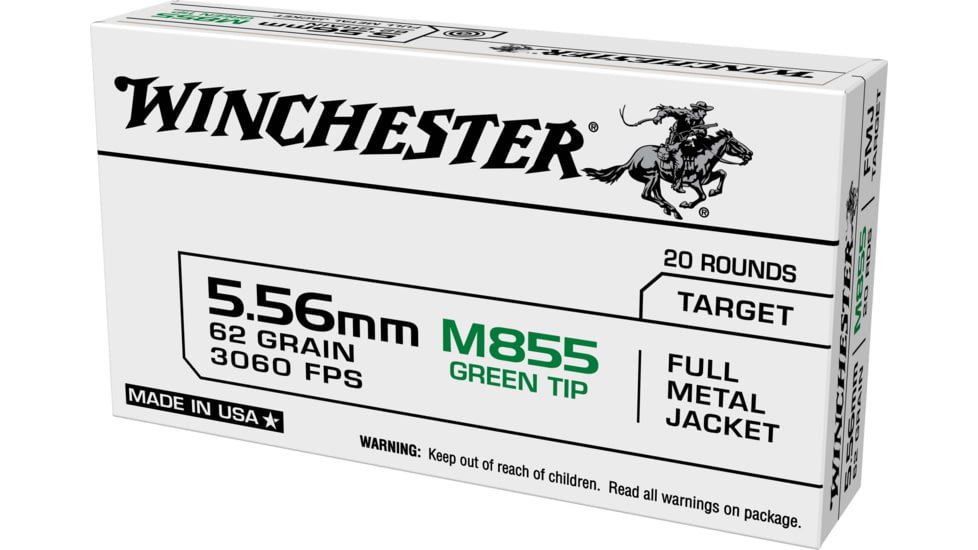
Winchester USA 5.56x45mm NATO 62 grain Green Tip (M855) Full Metal Jacket Boat Tail (FMJBT) Brass Centerfire Rifle Ammunition 500RDS
Original price was: $500.00.$300.00Current price is: $300.00.
Guaranteed safe checkout




Description
Description
Winchester USA 5.56×45mm NATO 62 Grain Green Tip (M855): Overview
Winchester USA 5.56×45mm NATO 62 grain Green Tip (M855) ammunition is a centerfire rifle cartridge configuration commonly associated with the 5.56×45mm NATO cartridge family. The M855 designation refers to a 62-grain projectile configuration with a green-painted tip, while FMJBT describes a full-metal-jacket projectile with a boat-tail profile. This overview explains the terminology and commonly stated specifications without making performance or purchasing claims.
Key Features
- Cartridge: 5.56×45mm NATO
- Projectile weight: 62 grains
- Projectile designation: M855 / Green Tip
- Bullet construction: Full Metal Jacket
- Profile: Boat Tail (FMJBT)
- Case material: Brass
- Cartridge type: Centerfire rifle ammunition
- Manufacturer/brand: Winchester USA
- Pack quantity specified: 500 rounds
Understanding the M855 Designation
M855 is a widely recognized designation for a 62-grain 5.56×45mm NATO cartridge configuration. The green tip is a visual identifier associated with this projectile type.
The term FMJ, or Full Metal Jacket, describes a projectile in which the core is substantially enclosed by a metal jacket. BT, or Boat Tail, refers to the tapered rear portion of the projectile.
These terms describe physical characteristics of the cartridge rather than guaranteeing a particular result in every firearm.
For readers researching cartridge specifications, see our Hornady 204 Ruger 32 Grain V-MAX.
What Does 5.56×45mm NATO Mean?
5.56×45mm NATO is a standardized rifle cartridge specification used by military forces and also encountered in civilian firearms chambered for compatible ammunition.
Although the dimensions of 5.56×45mm NATO and .223 Remington are closely related, they are not simply interchangeable designations. Firearm manufacturers’ chamber specifications should always be followed when determining appropriate ammunition.
Brass Case Construction
This Winchester USA configuration uses brass cartridge cases. Brass is a common cartridge-case material because of its established use in centerfire ammunition manufacturing and its mechanical characteristics.
The case forms the outer body of the cartridge and contains the primer and propellant while supporting the projectile at the front.
How to Use This Information Safely
Always consult the firearm manufacturer’s owner’s manual and ammunition markings before using any cartridge. Confirm that the ammunition designation is appropriate for the specific firearm.
Basic ammunition-safety practices include:
- Treat every cartridge as potentially hazardous.
- Keep ammunition away from heat, flames, and sources of ignition.
- Store ammunition securely and separately from unauthorized access.
- Inspect cartridges for visible damage before handling or use.
- Never attempt to modify or disassemble ammunition.
- Follow applicable laws, regulations, and manufacturer instructions.
Specifications
- Brand: Winchester USA
- Caliber/cartridge: 5.56×45mm NATO
- Bullet weight: 62 grains
- Bullet type: Full Metal Jacket
- Projectile profile: Boat Tail
- Designation: M855
- Tip identification: Green tip
- Case: Brass
- Ammunition category: Centerfire rifle
- Quantity: 500 rounds
Understanding the Cartridge Designation
5.56×45mm NATO
The 5.56×45mm NATO designation identifies the cartridge’s standardized dimensions and military specification family. The name refers broadly to the cartridge’s nominal dimensions: approximately 5.56 mm projectile diameter and a 45 mm case length.
The NATO designation is important because ammunition compatibility depends on the firearm’s chamber specification. Users should always verify the chambering marked on their firearm and consult the manufacturer’s documentation rather than relying solely on caliber names.
62-Grain Projectile
The 62-grain specification identifies the approximate projectile weight. A grain is a traditional unit used extensively in ammunition specifications.
Projectile weight is one of several characteristics used to distinguish different cartridge configurations. Other variables include projectile construction, profile, propellant characteristics, and cartridge dimensions.
What the “Green Tip” Indicates
The phrase Green Tip generally refers to the colored identification marking applied to the projectile tip. In the M855 context, green identification has traditionally been associated with this particular 62-grain projectile configuration.
Color markings should not be interpreted in isolation, however. Ammunition packaging and manufacturer’s specifications provide more reliable identification information than projectile color alone.
Readers interested in 300 Blackout specifications can also review our product to Barnes 300 BLK.
Full Metal Jacket Explained
Full Metal Jacket (FMJ) describes the projectile’s construction. A metal jacket surrounds the projectile’s core, leaving only a limited portion of the projectile exposed depending on the particular design.
FMJ is a common projectile construction found across numerous centerfire ammunition types. The term describes construction and should not be treated as a guarantee of accuracy, terminal behavior, or performance in an individual firearm.
Boat-Tail Projectile Profile
The Boat Tail (BT) portion of FMJBT refers to the shape of the projectile’s rear section. Instead of maintaining the same diameter all the way to its base, the rear portion tapers inward.
A boat-tail profile is a geometric feature of the projectile. Its presence does not, by itself, establish a particular performance result because ammunition behavior depends on the complete cartridge design and the firearm in which it is used.
Brass Cartridge Case
The specified ammunition uses brass cases. Cartridge cases serve several important mechanical functions within a centerfire cartridge. They contain the primer and propellant and provide the structural body into which the projectile is seated.
Brass has long been used for centerfire cartridge cases because of its established mechanical properties and suitability for ammunition manufacturing.
Centerfire Ammunition
This configuration is classified as centerfire ammunition. The term refers to the location of the primer in the center of the cartridge case head.
When a compatible firearm is fired, the firing mechanism strikes the primer, initiating the ignition sequence. Ammunition should never be intentionally altered, disassembled, or modified.
Winchester USA Terminology
The Winchester USA name identifies the ammunition brand associated with this configuration. Winchester produces multiple ammunition lines and cartridge configurations, so similar-looking product names should not automatically be assumed to have identical specifications.
For example, references such as Winchester USA 5.56, Winchester USA 5.56 NATO ammunition, and Winchester USA Valor 5.56 can refer to different configurations or product lines. Exact packaging and manufacturer specifications should therefore be used when identifying a particular cartridge.
Related Winchester USA Configurations
Searches for Winchester USA ammunition may also produce references to configurations such as:
- Winchester USA 5.56
- Winchester USA 5.56 NATO ammunition
- Winchester USA Valor 5.56
- Winchester USA Valor 5.56 Green Tip
- Winchester USA Valor 5.56 M193 55 grain FMJ
- Winchester USA 5.56 50 grain jacketed frangible
- Winchester USA Ready 9mm
These names should not be treated as interchangeable. Cartridge caliber, projectile weight, projectile construction, and specific product designation can differ substantially between configurations.
Identification Checklist
When examining a box of ammunition, useful identifying information includes:
- Cartridge designation — such as 5.56×45mm NATO.
- Projectile weight — expressed in grains.
- Projectile type — such as FMJ.
- Projectile profile — such as boat-tail.
- Product designation — such as M855.
- Case material — such as brass.
- Manufacturer information — useful for verifying specifications.
- Packaging markings — useful for confirming the exact configuration.
Frequently Asked Questions
What is Winchester USA 5.56 ammunition?
Winchester USA is a line of ammunition associated with Winchester. The specific configuration described here is a 5.56×45mm NATO cartridge using a 62-grain M855-style projectile.
What does M855 mean?
M855 is a designation associated with a 62-grain 5.56×45mm NATO projectile configuration. The projectile is commonly identified by its green-painted tip.
What does FMJBT mean?
FMJBT stands for Full Metal Jacket Boat Tail. FMJ describes the projectile’s jacket construction, while Boat Tail describes its tapered rear profile.
Is 5.56×45mm NATO the same as .223 Remington?
They are closely related cartridges, but they are not identical specifications. Firearm chambering and manufacturer guidance should always be checked rather than assuming compatibility.
Why is the projectile called “Green Tip”?
The green paint on the projectile tip is a visual identification characteristic associated with the M855 designation. It should not be interpreted as a universal indicator for every cartridge with a green-colored projectile tip.
Conclusion
Winchester USA 5.56×45mm NATO 62 grain Green Tip (M855) Full Metal Jacket Boat Tail (FMJBT) Brass Centerfire Rifle Ammunition 500RDS describes a specific 5.56×45mm NATO cartridge configuration characterized by a 62-grain M855 projectile, FMJ construction, boat-tail profile, and brass case. Understanding these specifications can help readers interpret ammunition markings and distinguish cartridge characteristics while emphasizing the importance of firearm compatibility, responsible handling, and applicable safety requirements.
Specifications
- Short Stroke Gas Piston Gas System (Rifle Length)
- 18.6″ Barrel Length ( Mid-Weight style, non-fluted)
- 1:8 Twist Rate Rifling
Reviews
There are no reviews yet.